Reading the Machine: What "Reviewed 8 Files" Really Means
Agent progress messages summarize selected model, host, and tool events; they are useful clues, not direct proof of comprehension, hidden reasoning, or completed verification.
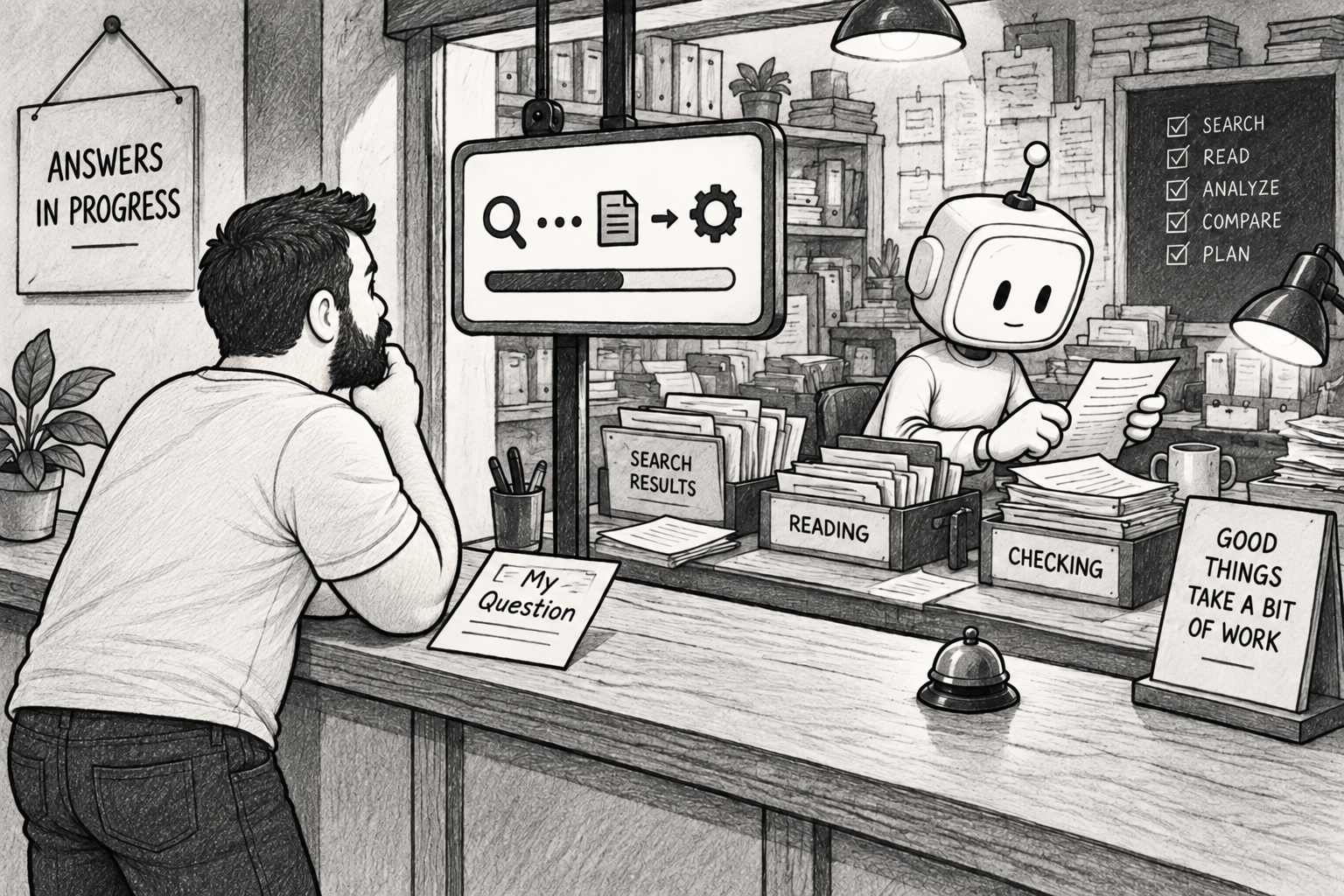
An agent interface says:
Reviewed 8 filesThe phrase may summarize useful work. It does not, by itself, reveal which files were selected, what operation accessed them, how much content entered model context, what the model understood, or whether the right files were included.
Progress text is a product layer over the agent loop. Read it as a compact interpretation of events, not as a direct window into an agent mind.
Events become narration
An application can directly record many operational events:
- a model response contained a tool request;
- a host authorized or rejected that request;
- a search tool started and returned 12 paths;
- a read tool returned contents for eight files;
- a command exited with a status code;
- a model call began or completed;
- a budget, cancellation, or stop rule ended the run.
An interface may transform that raw stream. It can select events, combine them, attach labels, and choose when to update the user. That transformation is progress narration.
A simple causal chain is:
loop and tool events
-> product selection and interpretation
-> short status phrase
The phrase can be accurate and still leave out important detail. Compression is the point: users usually do not need every transport event. The risk appears when compressed wording implies stronger evidence than the underlying events support.
Translate phrases back into possible events
Exact mappings vary by product. The useful habit is to ask what the interface likely observed and what remains inferred.
| Progress phrase | A plausible event-level interpretation | What the phrase alone does not prove |
|---|---|---|
Searching files... |
A search request was proposed, authorized, started, or is awaiting a result. | That relevant files were found or read. |
Reviewed 8 files |
Eight files were selected or their contents were returned through one or more tools. | That all eight were fully considered, that selection was complete, or that the model understood the codebase. |
Thinking... |
The product is waiting during a model invocation or another loop stage. | Direct access to hidden reasoning or a faithful causal trace. |
Running checks |
A build, test, or lint operation was requested or started. | That it completed, passed, or covered the right behavior. |
Applying edits |
A patch or write operation was proposed, attempted, or executing. | That the edit succeeded, compiled, or solved the task. |
Words such as requested, started, returned, failed, and passed can often attach to observable lifecycle events. Words such as understood, considered everything, or found the root cause usually contain more inference.
That does not make inferential language forbidden. It means the interface should not present inference as though it were raw telemetry.
What “Reviewed 8 files” can compress
Imagine this trace:
- The model proposes searching for
loadLegacyConfig. - The host executes a search tool.
- Search returns 12 matching paths.
- The host or model selects eight paths for reading.
- A read tool returns the contents of those eight files.
- The application assembles some or all of that content for another model call.
- The UI emits
Reviewed 8 files.
The count can be grounded in real read events. The verb reviewed still compresses several questions:
- Were all returned contents included, or were some truncated?
- Did the next context contain every file at once?
- Were the eight chosen by a deterministic filter, model output, or product heuristic?
- Did the selection omit a ninth file that controls the behavior?
- Did any subsequent check confirm the model’s interpretation?
The progress label is evidence that the product reports a review step. A detailed event log, tool result, or exposed trace can provide stronger evidence about what occurred. Neither automatically proves comprehensive understanding.
Attempt, completion, and verification are different states
Agent interfaces become misleading when one verb silently crosses several lifecycle boundaries.
Consider a test command:
requested -> authorized -> started -> completed -> result returned -> result interpretedRunning tests may be accurate at the started stage. Tests passed requires a completed result with the expected success signal. Verified the fix is stronger still: it implies that the chosen tests are relevant evidence for the claimed behavior and that the system interpreted them correctly.
A zero exit code is concrete evidence about one command execution. It does not prove that the test suite covers every requirement, that no unrelated regression exists, or that the environment matches production.
This is why status text cannot replace stop policy. A completed-looking phrase should not end a run unless the host’s actual completion conditions are met.
“Thinking” is a wait-state label
When a UI displays Thinking..., it may be waiting for a model response, a reasoning-enabled model stage, a queued request, or some combination of runtime work. Products can also show a generated or summarized rationale.
The label alone does not identify the model’s internal computation. Some providers keep chain-of-thought hidden or expose only summaries. Research has also shown that generated chain-of-thought explanations can be plausible while failing to report factors that influenced an answer in tested settings.
The bounded conclusion is not that every explanation is false. It is that visible reasoning text should not be treated as a guaranteed, complete trace of why a model produced an output. Tool events and returned observations offer a different kind of evidence: they provide inspectable records of what the runtime reports happened. Their reliability still depends on the tool and runtime, and they do not make every later interpretation correct.
Rewrite claims around observable evidence
Event-grounded language makes the evidence boundary easier to inspect.
| Overstated phrase | More grounded alternative |
|---|---|
I understood the whole repository. |
Searched for the target symbol and read eight matched files. |
I verified the fix. |
The targeted test command completed with a passing exit status. |
I considered every edge case. |
Generated an edge-case checklist from the supplied requirements; coverage still needs evidence. |
I found the root cause. |
The failing assertion and stack trace point to the parser as the most likely cause. |
Reviewed 8 files. |
Read eight files selected from the search results. |
The alternatives are not merely more cautious. They are more useful for debugging because each claim can be connected to a request, tool result, or explicit inference.
Good products may show a friendly summary, a raw trace, or both. They may omit low-value internal events to reduce noise. The standard is not maximal telemetry. It is a clear separation between what the system observed, what it inferred, and what remains unverified.
“The progress panel shows what the model did and thought.”
The panel shows what the product chose to narrate. Some entries may map closely to tool and runtime events; others may summarize or infer intent. Use the trace to ask better questions, not as automatic proof of hidden reasoning or completed work.
Four questions for reading an agent run
When a status message matters, ask:
- What operation likely occurred? Was there a model proposal, a host action, a provider-hosted tool, or only a UI update?
- What evidence returned? Look for output, counts, errors, exit status, or changed state.
- What is inferred? Separate facts such as
read eight filesfrom judgments such asunderstood the relevant code. - Why did the run continue or stop? Identify success checks, permission gates, budgets, retries, cancellation, or no-progress rules.
Those questions reconstruct the chapter’s full mechanism. A single model call proposes output from supplied context. Tool calling turns some outputs into externally executed requests. The orchestrator records observations, rebuilds state, and decides whether to invoke the model again. ReAct names the reason-act-observe rhythm. The UI then compresses selected events into language.
Once those layers are separate, an agent stops looking like one entity continuously thinking and acting. It becomes an inspectable system whose claims can be compared with the events that actually occurred.