Why Models Hallucinate
A language model can produce a plausible claim without checking it against evidence; grounding and verification add that missing work but cannot guarantee truth.
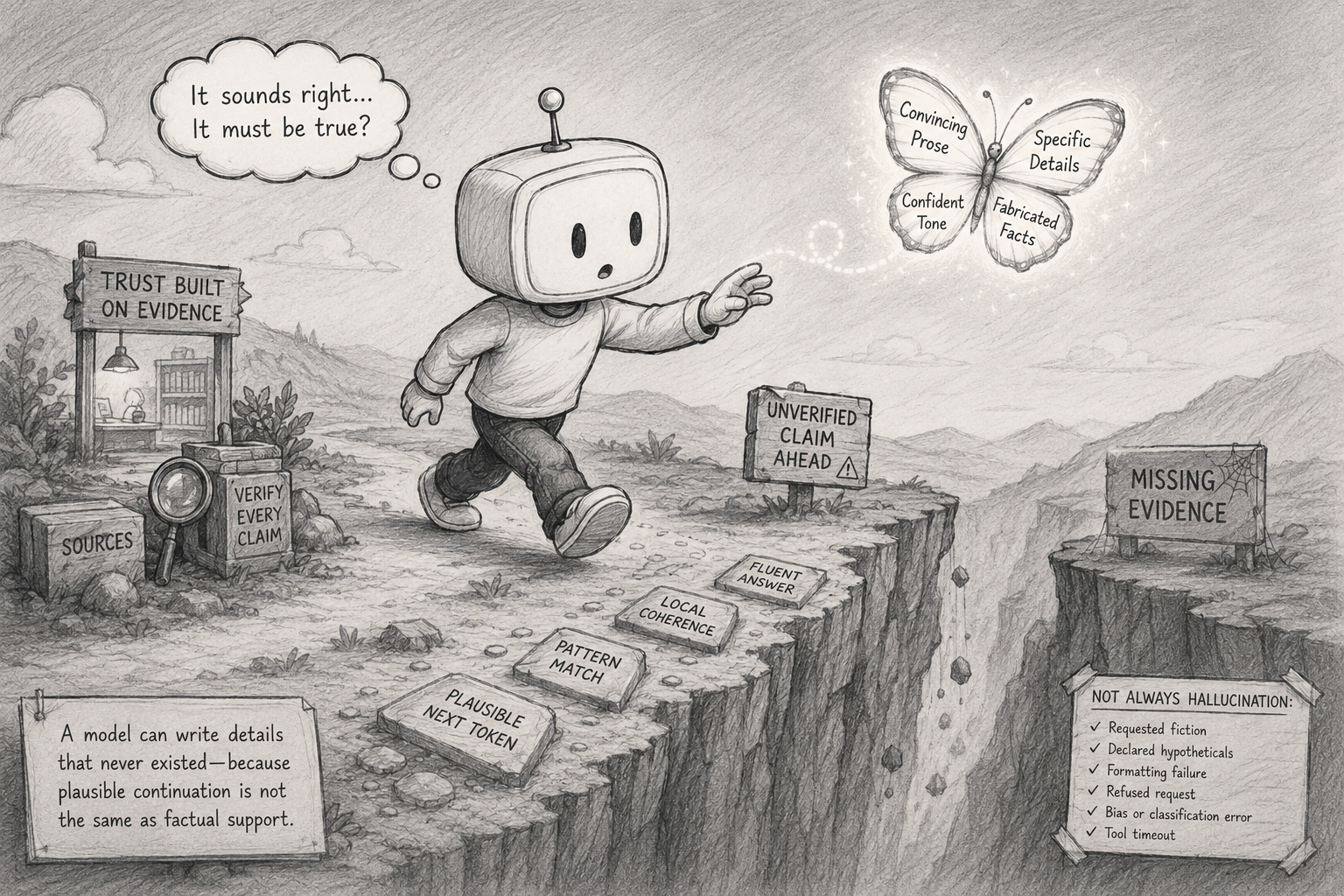
A language model can write a precise date, a convincing quotation, or a perfectly formatted citation without possessing evidence for any of them. The language may be coherent because coherence is part of what next-token generation is good at. The claim may still be unsupported.
This is the central mechanism behind many outputs described as hallucinations: plausible continuation and factual support are different properties.
The word hallucination is used differently across research tasks. Here it means content presented, or required, as factual that is false, contradicts the relevant source, or lacks the support the task requires. That definition does not include requested fiction, declared hypotheticals, or every bad model output. A formatting failure, a refused request, a biased classification, and a tool timeout can all be errors without being hallucinations.
Where the unsupported claim enters
At each generation step, a language model scores possible next tokens from its parameters and current context. Those scores reflect how well a continuation fits the model and the sequence so far. They are not probabilities that the completed statements are true.
The decoding policy selects a token, appends it, and repeats. This process can build a fluent claim one locally plausible piece at a time:
prompt -> next-token scores -> decoding -> fluent claimNothing in that baseline path guarantees a search for evidence, comparison with a trusted record, or claim-by-claim fact check. A product can add those operations around the model, but they are additional mechanisms.
That is why “the model sounded certain” is weak evidence. Confidence can be expressed as another plausible language pattern. Detail can make an answer easier to trust while giving it more unsupported parts that need checking.
A false premise can become fluent prose
Consider a deliberately fictional request:
Which 2019 paper by Dr. Lena Ortiz introduced the Meridian Compression Lemma?
Provide its DOI and a short proof sketch.
The prompt presupposes that the researcher, paper, and lemma exist. It also asks for forms that have strong patterns in technical writing: a title, DOI, publication venue, and proof.
An ungrounded generator can continue those patterns with invented specifics. Each token may fit the surrounding text even though the resulting citation has no supporting record. The output is not arbitrary; it is shaped by the prompt and learned regularities. That structure is exactly what makes the fabrication persuasive.
A better system treats the premise as a claim to establish, not an instruction to decorate. It searches an appropriate source, checks whether the author, paper, lemma, and DOI can be connected, and reports when the evidence is absent.
Even then, “I could not verify this” is not always the same as “this does not exist.” The searched corpus may be incomplete. The defensible result is often not established from the available evidence.
Generation, grounding, and verification
Three operations are often discussed as though they were one:
- Generation produces a continuation from model state and current context.
- Grounding places relevant external evidence into that context.
- Verification compares particular claims with suitable evidence, tools, or rules.
Grounding changes what the model can condition on:
sources or tools -> selected evidence -> current context -> generated answerVerification asks a different question after or during generation:
claim + appropriate evidence -> check -> supported / contradicted / not establishedThese flows are architectural abstractions, not a requirement that every application contain two literal pipelines. They are useful because they make responsibility visible. If a system has no evidence source and no check, polished prose should not be mistaken for a verified result.
Why grounding helps but does not certify
Retrieval-augmented generation can improve factual performance by supplying documents at request time. It is especially useful for current, private, or specialized information that should not be assumed to live in model parameters.
Retrieval can also fail:
- the query may miss the needed source,
- the retrieved passage may be related but not sufficient,
- the source may be stale or unreliable,
- relevant passages may conflict,
- the model may misread the evidence,
- the response may claim more than the source supports.
Return to the fictional lemma. A search result about a different compression theorem is topically similar, but it does not establish the requested author, date, name, or DOI. Putting that passage in the prompt creates grounded input, yet the requested claim remains unsupported.
Grounding therefore lowers some risks by improving evidence access. It does not turn generation into a truth guarantee.
Conditions that deserve more scrutiny
Hallucination has more than one cause, and no checklist predicts every failure. Still, several request shapes should increase your demand for evidence:
- a prompt contains a premise that has not been established,
- the requested entity is rare, obscure, or difficult to distinguish from similar entities,
- the answer depends on events beyond a model’s documented knowledge period,
- the request demands exact quotations, dates, identifiers, links, or citations without supplying a source,
- the available evidence is partial, conflicting, or indirect.
These are risk conditions, not proof that an answer will be wrong. Their practical consequence is to move verification earlier and make unsupported specificity easier to reject.
Consistency is not proof
One detection approach samples several responses and looks for contradictions or low agreement. Variation can reveal uncertainty: if repeated outputs invent different dates or names, trust should fall.
Agreement is weaker than it appears. The same model can reproduce the same learned error or follow the same false premise repeatedly. A stable answer can still be false, just as a variable answer can contain a supported claim.
Use consistency as a signal that can trigger inspection, not as a substitute for external evidence.
Common misconception
“Hallucination is a bug that appears when the model malfunctions.”
A software defect can contribute to a bad output, but unsupported generation can also arise while the decoding system behaves as designed. The model is producing a continuation that fits its context without a guaranteed factual-checking stage. The failure is in treating plausibility as sufficient evidence.
The opposite overstatement is also unhelpful: missing verification is not the only possible explanation for every hallucination. Training data, model behavior, decoding choices, prompt framing, and evidence quality can all affect the result.
A better trust boundary
For consequential claims, make evidence status part of the product behavior:
- Show which source supports which claim.
- Preserve the distinction between no evidence found and evidence of absence.
- Prefer authoritative, current sources over merely similar text.
- Check identifiers, quotations, and calculations with deterministic tools when possible.
- Allow the system to say that a claim is not established.
The goal is not to make the model sound less confident. It is to stop using the sound of confidence as the trust mechanism.
References
- The Curious Case of Neural Text DegenerationICLR, 2020
- Retrieval-Augmented Generation for Knowledge-Intensive NLP TasksNeurIPS, 2020
- Survey of Hallucination in Natural Language GenerationACM Computing Surveys, 2023
- SelfCheckGPTEMNLP, 2023